Startup Scaling Challenges: 8 Problems and How to Fix Them
Published
TL;DR
Most startup scaling challenges start with one mistake: spending like a scale-up before the business works like one. Startup Genome's study of more than 3,200 high-growth internet startups concluded that 74% of such startups fail due to premature scaling, and a 2026 CB Insights analysis of shut-down VC-backed startups found that 70% ran out of capital. Run the 8-point self-check below before you hire or raise, then fix problems in this order: retention, unit economics, cash, decisions, processes, hiring, tech debt, customer spread.

Want to practise scaling decisions before they cost real money?
Fe/male Switch is a startup game for women founders: you take a business from idea to first customers step by step, with an AI co-founder next to you.
What does scaling a startup mean, and how is it different from growth?
I'm Violetta Bonenkamp, founder of Fe/male Switch and CADChain, and I see founders confuse growth with scaling all the time.
Growth means revenue and costs rise together; with scaling, revenue rises faster than costs, so each new customer costs less to win and serve than the one before. A consultancy that adds one consultant for every three new clients is growing, while a software company serving 1,000 extra customers with the same support team is scaling.
The official yardstick is strict. Eurostat defines a high-growth enterprise as a company with at least 10 employees at the start of a three-year period whose headcount grew by more than 10% a year on average over those three years. Turnover can replace headcount, and some studies use a 20% bar.
Real scale-ups are rare. According to Eurostat's business demography statistics, the EU had about 180,200 high-growth enterprises in 2024, or 10.0% of all active companies with 10 or more employees, employing 14.1 million people. Ireland had the highest share (19.9%) and Cyprus the lowest (2.2%).
| Growth | Scaling | |
|---|---|---|
| Revenue and costs | Rise together | Revenue rises faster |
| Each new customer | Costs the same to win and serve | Costs less than the last |
| Team | Grows with sales | Grows slower than sales |
| Founder's job | Doing the work | Building the system |
Here is why the difference matters: a growing business can die the day the money stops, while a scaling business pays more of its own way every month.
Why do startups fail when they try to scale?
Two data sets, 15 years apart, point at the same culprit.
Startup Genome (2011). Its report on premature scaling studied more than 3,200 high-growth internet startups. A startup scales prematurely when one part of the business (team, product, business model or finances) runs ahead of the customer side. The findings:
- 70% of the startups scaled prematurely in at least one area, and 74% of high-growth internet startups fail due to premature scaling.
- No startup that scaled prematurely passed 100,000 users, and 93% of them never broke $100,000 in monthly revenue.
- Startups that scaled at the right moment grew about 20 times faster.
- Founders needed 2 to 3 times longer to validate their market than they expected, and that gap created the pressure to scale early.
CB Insights (March 2026). Its analysis of 431 VC-backed companies that shut down since 2023 identified reasons for 385 of them: 70% ran out of capital, 43% had poor product-market fit, 29% had bad timing and 19% had unsustainable unit economics (one company can have several reasons). Two-thirds of those with headcount data were shrinking in their last 6 months, and the median time from the last funding round to shutdown was 22 months.
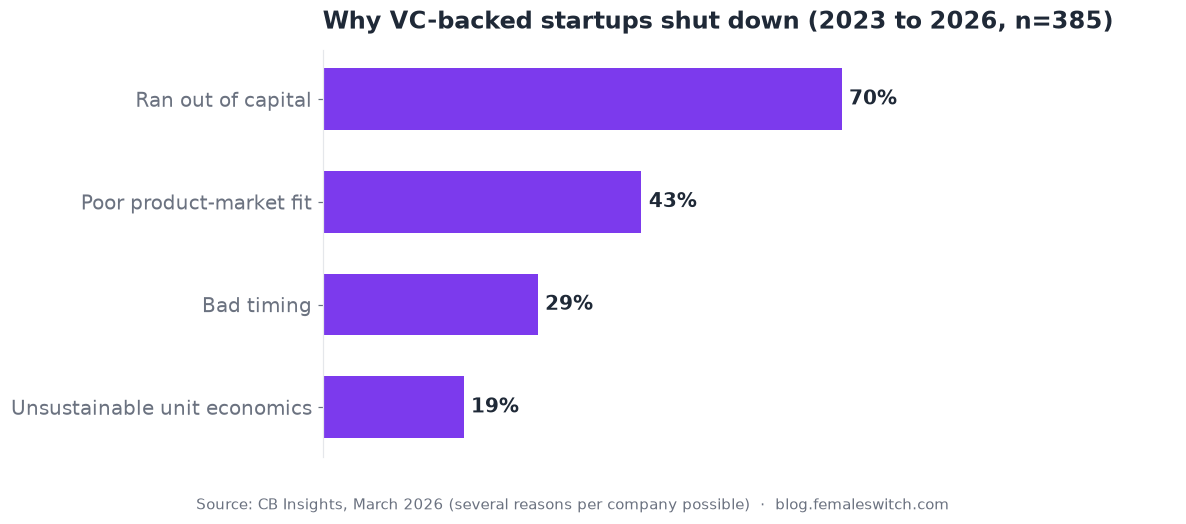 Shutdown reasons of 385 VC-backed startups, CB Insights, March 2026.
My reading of both studies: running out of cash is how a startup dies, and premature scaling is what burns the cash.
What are the most common startup scaling challenges?
These 8 problems come up again and again when founders go from startup to scale-up.
| # | Challenge | Warning sign | Evidence |
|---|---|---|---|
| 1 | Premature scaling | Spend and hiring rise, retention stays flat | 74% of high-growth internet startups fail from it (Startup Genome, 2011) |
| 2 | Hiring too fast | Nobody knows who decides what | Teams 3 times bigger at the same stage (Startup Genome, 2011) |
| 3 | Founder bottleneck | Every decision waits for you | 50% of founders no longer CEO by year 3 (HBR, 2008) |
| 4 | Processes that break | The same mistake twice a week | Our rule of thumb: breaks at 50 to 200 customers |
| 5 | Cash and funding gap | Under 12 months of runway | 70% of shutdowns ran out of capital (CB Insights, 2026) |
| 6 | Unit economics | Cost per new customer rises each quarter | 19% of shutdowns (CB Insights, 2026) |
| 7 | Tech debt | Releases slow as the team grows | 3.4 times more code too early (Startup Genome, 2011) |
| 8 | Customer concentration | One client pays over a fifth of revenue | US disclosure rule at 10% of revenue (ASC 280) |
1. Premature scaling
You hire a sales team or open a second country before customers stay and pay on their own. Startup Genome found that prematurely scaled startups were 2.3 times more likely to spend well above average on customer acquisition. The test: if most customers you won three months ago have left, more marketing only fills a leaking bucket faster.
2. Hiring too fast and losing the culture
In Startup Genome's data, prematurely scaled teams were 3 times bigger than well-paced startups at the same stage. The well-paced ones took 76% longer to reach their team size and still ended up 38% bigger at the scale stage.
The second risk is first-time managers. Gallup's State of the Global Workplace 2026 report puts manager engagement at 22% in 2025, down from 27% in 2024. Turn your best early employee into a manager without training, and you can lose a great specialist and the people under them in one move.
3. The founder bottleneck and slow decisions
A founder who decides everything is fast in a team of 5 and becomes a queue in a team of 40. Noam Wasserman's study of 212 American startups, published in Harvard Business Review in 2008, found that 50% of founders were no longer CEO by year three, only 40% still held the job in year four, and fewer than 25% led their company's IPO. Four out of five were forced to step down.
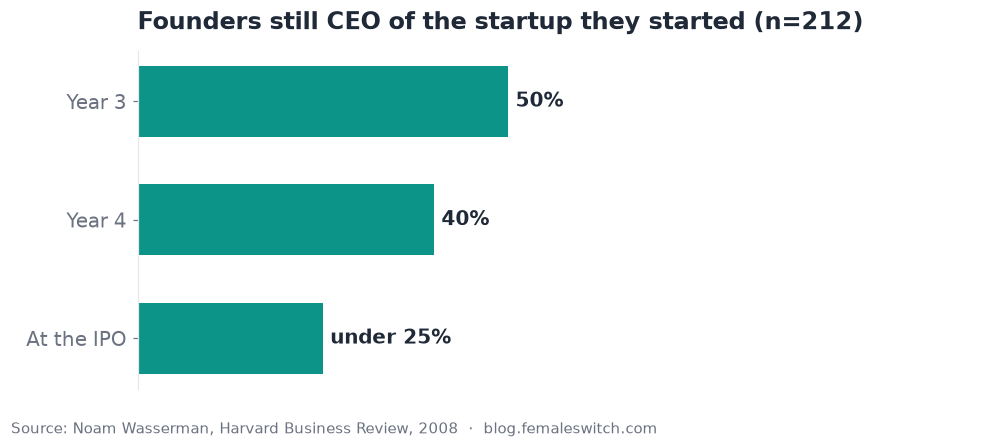 Founders still CEO of their startup, Noam Wasserman's study of 212 US startups, 2008.
If you want to keep the job, give decisions away on purpose: list the ones you keep (senior hires, pricing, fundraising), hand over the rest, and review the list every quarter. Founder Mode On collects operating rules and decision filters for exactly this stage.
4. Processes and systems that break
Spreadsheets, a shared inbox and "ask the founder" work for the first 20 customers. Somewhere between 50 and 200 customers (our rule of thumb), the same errors repeat: late invoices, new clients waiting days for set-up, two people answering one support ticket. Write down the five processes that touch money and customers first: selling, customer set-up, support, invoicing and hiring.
5. Cash and the growth-stage funding gap
Scaling eats cash before it returns any: you pay for hires, stock and marketing months before the revenue arrives, and the 22-month clock from the CB Insights data starts at your last round.
European founders face a thinner market for later rounds. A European Commission page from March 2025 says around 60% of the world's scale-ups are based in North America and only 8% in the EU, and that later-stage venture capital in the EU was about $20 billion in 2021 against $103 billion in the US. The EU's answer, the Scaleup Europe Fund, launched on 3 June 2026 with EQT as manager, targets about €5 billion and invests in rounds of €100 million and above in fields like AI, quantum, space and biotech.
If your next round in 2027 is €3 million, that fund won't call you. Plan for revenue, smaller rounds and startup grants, and read our guide to startup funding stages to see what investors expect at each step.
6. Unit economics that break at volume
Your first customers came from your network; the next 1,000 come from paid channels, and each one costs more. Watch three numbers monthly: gross margin per customer, customer acquisition cost (CAC), meaning sales and marketing spend divided by new customers, and CAC payback, the months a customer's gross margin needs to cover that cost. If gross margin falls as volume rises, you are buying revenue at a loss.
7. Product and tech debt
Tech debt is the extra work you create when you pick a quick fix over a sturdier build: shortcuts in code, missing tests, tools glued together by hand. It turns into a scaling problem when every new feature breaks two old ones. Startup Genome found that prematurely scaled startups wrote 3.4 times more code in the discovery phase and outsourced 4 to 5 times as much product development, building big before they knew what customers wanted. Our rule of thumb once the product is stable: reserve about 20% of engineering time for cleanup.
8. Customer concentration
One big client feels like a win until they renegotiate, pay late or leave. Under US accounting rules (ASC 280-10-50-42), a public company must disclose any single customer that brings in 10% or more of revenue. Our rule of thumb before you scale: no customer above 20% of revenue, and the top 5 together below half.
Are you ready to scale? An 8-point self-check
Answer yes or no. Lines marked "our rule of thumb" are our own judgement; the rest come from published research.
- Customers would miss you. At least 40% of active users would be "very disappointed" if they could no longer use your product. Sean Ellis set this benchmark after surveying nearly a hundred startups, as First Round Review reports.
- Retention has flattened. In your last three monthly cohorts, the share of active customers stops falling after month 3 (our rule of thumb).
- Customers pay back fast. CAC payback is under 12 months, or lifetime value is at least 3 times CAC (our rule of thumb).
- Margins hold at volume. Gross margin stayed flat or rose the last time volume doubled (our rule of thumb).
- The runway covers the plan. At least 18 months of cash after your hiring plan is paid for (our rule of thumb).
- Someone else can sell. At least one person besides the founder closes deals with your standard pitch (our rule of thumb).
- Processes live on paper. Your five money-and-customer processes each have a one-page checklist a new hire can follow (our rule of thumb).
- No customer dominates. No single customer pays more than 20% of revenue (our rule of thumb).
Your score (our scoring): 7 or 8 yes and you are ready to scale. Fix the gaps first, in the order below, if you score 5 or 6. At 4 or fewer you are still validating, and growth spending now repeats the Startup Genome pattern.
How do you scale a startup without breaking it?
Fix what burns cash first, then what slows the team down.
- Prove retention. Pause new marketing spend until lines 1 and 2 of the self-check are a yes, and talk to the customers who left.
- Repair unit economics at today's volume. Raise prices, cut the most expensive channel and fix gross margin. Model it in our startup business plan financial template.
- Secure 18 months of runway or more. Combine revenue, grants and equity, and raise when your numbers are strongest. Our free pitch deck template helps you tell the scaling story.
- Hand over decisions. Write a decision list (yours, the team's, joint) and close open decisions in one weekly meeting.
- Write down the five money-and-customer processes. The business startup checklist covers the admin side.
- Hire for the bottleneck. Add the role that removes today's constraint, train managers before they start managing, and keep headcount growing slower than sales.
- Pay down tech debt on a schedule, about 20% of engineering time (our rule of thumb).
- Spread customer risk, then accelerate. At a self-check score of 7 or more, grow acquisition with a written startup marketing plan, one new channel at a time.
Each step pays for the next: higher retention makes marketing cheaper, and the margin you win back stretches the runway you need to hire well.
FAQ
What are the biggest challenges of scaling a startup?
Premature scaling, hiring too fast, the founder bottleneck, broken processes, cash gaps, weak unit economics, tech debt and customer concentration. Startup Genome and CB Insights data put premature scaling and running out of capital at the top.
How do you scale a startup?
Prove that customers stay, make each customer profitable at today's volume and secure 18 months of runway. Then hand over decisions, write down processes, hire for the bottleneck, and raise acquisition spend last.
When is a startup ready to scale?
When at least 40% of active users would be "very disappointed" without your product, retention has flattened and each customer earns back its acquisition cost within about a year. A score of 7 or more on the self-check above means go.
What is the difference between a startup and a scale-up?
A startup is still searching for a business model that works; a scale-up has found one and grows fast. Eurostat counts a company as high-growth when it had at least 10 employees and grew headcount (or turnover) by more than 10% a year over three years. In 2024 about 1 in 10 EU companies with 10 or more employees met that bar.
Why do so many startups fail when they scale?
They let one part of the business run ahead of the customers. Startup Genome found that 74% of high-growth internet startups fail for this reason, and in CB Insights' 2026 analysis 70% of shut-down startups ran out of capital.
What should you do next?
Run the 8-point self-check with your co-founder this week and start with the first "no" in the fix order. Fix one thing per month, then score again. If you want to practise hiring, pricing and funding decisions before they cost real money in 2027, play Fe/male Switch, the startup game for women founders who want to build a company that lasts.