Business Startup Checklist Template: 40 Steps to Launch
Updated · First published
TL;DR
This business startup checklist template walks you through 40 steps in 6 phases: validate the idea, plan the business on paper, make it legal, set up money and tools, launch, and run the first 90 days. Copy it into a document or spreadsheet, tick it off in order, and don't skip phase 1. Most failed startups did the legal paperwork perfectly for a product nobody wanted.

Rather follow a guided path than a list?
Fe/male Switch is a startup game where women founders go from idea to first customer step by step, with an AI co-founder that checks your work.
What is a business startup checklist?
A startup checklist is the ordered list of everything you do between "I have an idea" and "customers pay me every month". I'm Violetta Bonenkamp, founder of Fe/male Switch and co-founder of CADChain, and I use the same order with every founder I work with: proof first, paperwork second, promotion third. Registering a company takes a day. Finding people who pay takes weeks, so that comes first.
The checklist below works for a service business, a shop and a tech startup. Country-specific notes for the EU, the Netherlands and the US follow after it.
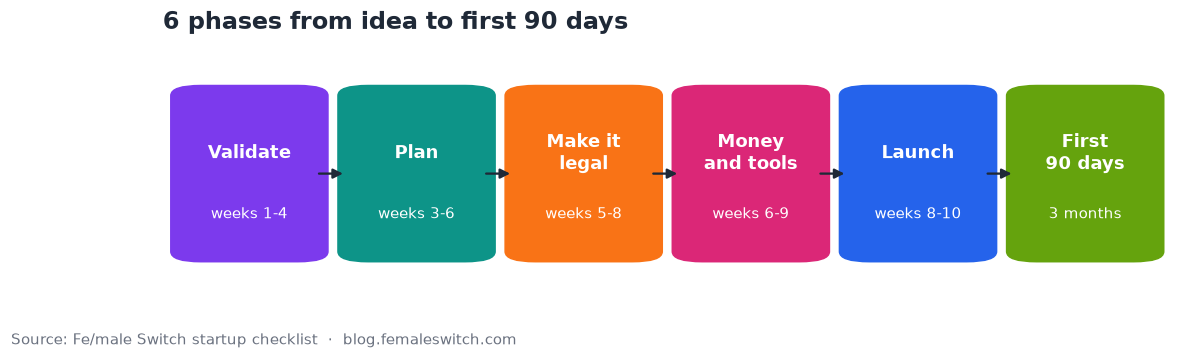
The business startup checklist template
Phase 1: Validate the idea (weeks 1 to 4)
- Write the problem in one sentence with a specific person in it ("freelance designers lose a day a month chasing invoices").
- Interview 10 to 15 people who have that problem. Ask what they do today and what it costs them.
- List 5 competitors or alternatives, with prices and the complaints in their reviews.
- Describe your offer and price in 3 lines.
- Get a first commitment: a pre-order, a paid pilot, a deposit or at least a signed letter of intent.
- Decide: go, change the idea, or drop it. Write down why.
Stuck on the idea itself? Our business project ideas include a scoring sheet for comparing options.
Phase 2: Plan the business on paper (weeks 3 to 6)
- Fill in a one-page business model. Our business model canvas examples show it done for real companies and small startups.
- Build a simple financial plan: startup costs, monthly fixed costs, price, cost per sale, break-even point. A startup financial plan template saves you hours.
- Decide how you fund the first 12 months: savings, first customers, grants, a loan or investors. The startup funding stages explain each option.
- Choose a name and check the domain, social handles and trademark registers. See how to choose a business name.
- Write a 90-day marketing plan. The startup marketing plan example gives you a ready structure.
Phase 3: Make it legal (weeks 5 to 8)
- Choose a legal form: sole trader (simplest, personal liability) or a limited company (separate liability, more admin). Ask an accountant if you will have co-founders, investors or real risk.
- Register the business with your country's business register.
- Get your tax numbers and register for VAT or sales tax if your sales or your country's rules require it.
- Open a separate business bank account.
- Check licences and permits for your sector and city (food, childcare, alcohol, health and building work all need extra permits).
- Get insurance: liability insurance at a minimum, plus professional indemnity for advice and design work.
- Sign a co-founder agreement if you have co-founders: shares, roles, vesting and what happens when someone leaves.
- Protect your intellectual property: who owns the code, designs and content. Get it in writing with every freelancer.
- Write a privacy policy and terms of service. If you handle personal data of people in the EU, the GDPR applies, wherever your company sits.
Phase 4: Set up money and tools (weeks 6 to 9)
- Pick accounting software and keep every receipt from day one.
- Set up invoicing and online payments.
- Get a domain, a business email address and a simple website with your offer, price and contact details.
- Create your profiles on the 1 or 2 channels where your customers already spend time.
- Prepare a simple contract or order confirmation for your service or product.
- Put the tax deadlines for your first year in your calendar.
Phase 5: Launch (weeks 8 to 10)
- Contact everyone from your phase 1 interviews and offer them the first spots.
- Announce the launch to your personal network with a clear ask ("who do you know who…").
- Run one channel well before you add a second.
- Ask every early customer for a review or testimonial.
- Fix the 3 most common complaints within two weeks.
Phase 6: Run the first 90 days
- Track 5 numbers every week: leads, sales, revenue, cash in the bank, hours worked.
- Hold a 30-minute review every Friday: what worked, what didn't, one change for next week.
- Raise your price once you have more demand than time.
- Write down your sales process so someone else can follow it.
- Decide at day 90: double down, change course, or stop.
That's 40 steps. Copy them as they are or delete what doesn't apply to your business.
How long does it take to start a business?
| Phase | Typical duration | Can you do it faster? |
|---|---|---|
| Validate the idea | 2 to 4 weeks | Yes, with a pre-order page and 10 calls in one week |
| Plan on paper | 1 to 3 weeks | Yes, if phase 1 gave you clear answers |
| Make it legal | 1 day to 4 weeks | Sole trader registration takes a day in many countries; companies and permits take longer |
| Money and tools | 1 to 2 weeks | Yes |
| Launch | 1 to 2 weeks | Yes |
| First 90 days | 3 months | No: you need the data |
So a service business can go from idea to first paying customer in 4 to 6 weeks. Products with stock, licensed sectors and tech startups take longer.
What changes by country?
The steps stay the same everywhere. The forms and offices differ:
- European Union, selling online to consumers in other EU countries: since 1 July 2021 a single EU-wide threshold of €10,000 a year applies to cross-border distance sales and digital services. Above it, you charge the VAT of the customer's country and can declare it through the One Stop Shop in your own country instead of registering everywhere. The Dutch Chamber of Commerce explains it in its guide to VAT rules for e-commerce in the EU.
- Netherlands: you register at the KVK, the Dutch Chamber of Commerce, which also passes your details to the tax office. Our guide to starting a business in Sweden covers another EU country step by step.
- United States: you register an LLC or corporation with your state, and you can get an Employer Identification Number (EIN) free from the IRS. Under FinCEN's beneficial ownership rules (an interim rule from March 2025, made final with effect from 14 August 2026), companies created in the US and their US owners no longer file beneficial ownership reports; the duty remains for certain foreign companies.
Rules change, so check your own country's official business portal before you register.
Which startup checklist mistakes cost founders the most?
- Registering before validating. A company with no customers still costs accounting fees, insurance and filing deadlines.
- No written co-founder agreement. It is the cheapest document you'll ever sign and the most expensive one to skip.
- Mixing personal and business money. It turns tax season into a week of detective work.
- Freelancers without contracts. Without a written transfer, the designer or developer can keep the rights to what they made for you. Protecting design files gets serious in hardware: CADChain writes about CAD file protection for founders who share engineering files.
- Five channels at once. Pick the one where your interviewees said they look for solutions, and do it properly.
FAQ
What should be on a startup checklist?
Six phases: validate the idea with real people, plan the business and the money, register and get tax numbers, set up banking and tools, launch to your first customers, and track your numbers for 90 days. The template above lists 40 concrete steps.
What is the first step in starting a business?
Talking to 10 to 15 people who have the problem you want to solve. Registration, logos and websites come later, once you know people will pay.
Do I need a business plan to start a business?
You need a plan, and it can fit on one page. A business model canvas plus a simple financial sheet is enough to start; banks and investors will ask for a fuller plan later.
How much money do I need to start a business?
Service businesses start with a few hundred to a few thousand euros. Shops with stock, food businesses and hardware need more. Your financial plan from phase 2 gives your real number.
Can I start a business while working full time?
Yes. Phases 1 and 2 fit into evenings and weekends, and many founders keep their job until the business pays a minimum income. Check your employment contract for rules on side businesses first.
What should you do next?
Copy the checklist, put a date next to every phase 1 step, and book your first 3 customer interviews this week. If you want the same steps as a guided game, with feedback on every move, play Fe/male Switch, the startup game for women founders.