How to Choose a Business Name: 7 Steps and Legal Checks
Updated · First published
TL;DR
To choose a business name, write one sentence about who you serve, brainstorm at least 50 names with 4 different methods, cut them to 10 with a simple filter, check the domain, social handles, trademark registers and company register, then let 10 real customers pick from the last 3. The whole job fits in one focused week. The name has to be easy to say, easy to spell and legally yours; cleverness comes last.

Got a name? Now get a first customer.
Fe/male Switch is a startup game where women founders take an idea from name to first sale, step by step, with an AI co-founder next to them.
How long should choosing a business name take?
I'm Violetta Bonenkamp, founder of Fe/male Switch and CADChain, and I have named, renamed and regretted more company and product names than I like to admit. My rule after all of that: give it one week, then decide. Founders who spend three months on a name spend three months without customers.
A week is enough because the hard part of naming in 2027 is availability, and that you can check fast. The internet ended the third quarter of 2026 with 411.6 million registered domain names, according to Verisign's Domain Name Industry Brief. TMview, the free trademark search of the EU trademark office, held more than 136 million trademarks from 81 offices by December 2025, as the European Commission's IP Helpdesk reported. Your job is to find a name that is free in your market and your category, a much smaller problem.
Names also change: Google's own company history says the search engine was first called Backrub.
How do you choose a business name in 7 steps?
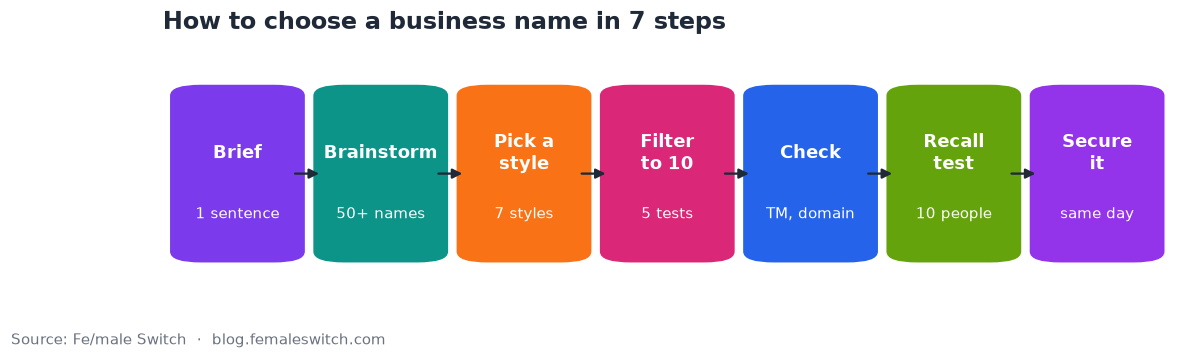
Here is the method I use with founders in the game:
- Write a one-sentence brief. Who do you serve, what do you solve, how should it feel, and where do you sell? "Meal plans for busy nurses on night shifts, warm and practical, sold online in the Netherlands and Belgium."
- Brainstorm at least 50 names. Use 4 methods from the next section and judge nothing yet.
- Choose a naming style. The table below shows what each style costs you.
- Filter down to 10. Strike out every name that fails the radio test (say it out loud, can a stranger type it?), is longer than about 15 characters, locks you into one product or city, or means something awkward in the languages of your customers.
- Run the availability check on all 10. Domain, social handles, trademark registers, company register. Keep the 3 that survive.
- Test the last 3 with 10 real customers. Show them the names in a short message, then contact them the next day and ask which one they remember. Recall beats "I like it".
- Secure the winner the same day. Buy the domain, claim the handles, register the company or trade name, and put a trademark application on your list once you have revenue.
If every name fails step 5, go back to step 4. Never argue with a register.
Which brainstorming methods give the best business name ideas?
Use at least four of these:
- Word bank. Write 20 words about the problem, 20 about the result and 20 about the feeling. Combine across columns: "Night" + "Plate" gives Night Plate.
- Customer language. Read reviews of competitors, forums and Reddit threads. Customers' words for their problem beat founders' words for their product.
- Metaphor and story. Pick an animal, place, myth or object that carries the feeling you want. Amazon and Patagonia point at something big and wild without describing a shop or a jacket.
- Other languages. Latin, Greek, Dutch, Swahili, Japanese. Check the meaning with a native speaker before you fall in love.
- Twist a real word. Drop a vowel, change a letter, add a suffix. Google is a play on the mathematical term for 1 followed by 100 zeros.
- Your own name or a place. IKEA combines the initials of founder Ingvar Kamprad with Elmtaryd, the farm where he grew up, and Agunnaryd, the nearby village, as IKEA explains on its own site.
Need raw material? Our big list of business name ideas gives you hundreds of starting points by industry, creative business names collects playful options, and online store name ideas sorts shop names by niche.
Which naming styles work, with examples?
Every style trades clarity today against ownership tomorrow. Descriptive names explain themselves and are hard to protect; invented names are easy to protect and need marketing money to mean anything.
| Style | How it works | Examples | Best for | Watch out for |
|---|---|---|---|---|
| Descriptive | Says what you do | Booking.com, The Body Shop | Local services, first-time founders on a small budget | Hard to trademark, easy to copy |
| Evocative | A real word with the right feeling | Amazon, Patagonia, Slack | Consumer brands with a story | Needs a clear tagline at the start |
| Invented | A new word | Kodak, Zalando | Tech and brands planning to grow abroad | Means nothing until you spend on marketing |
| Compound | Two words glued together | Facebook, YouTube, Netflix | Apps, online services | Spelling and spacing confusion |
| Founder or place | A person or location | Ford, Dell, Ben & Jerry's | Personal brands, handmade goods, food | Harder to sell the company, ties you to one place |
| Acronym or initials | Letters with a story behind them | IKEA, H&M | Companies already known for something | Initials of a new company say nothing to anyone |
| Twisted word | A real word, respelled | Google, Lyft, Tumblr | Online brands that need a free .com | People type the "correct" spelling and land elsewhere |
My take for a new founder in 2027: evocative or compound names give the best mix. They are easier to remember than invented words and easier to protect than descriptive ones.
How do you use a business name generator well?
A business name generator is a word machine: use its output as ingredients and do the choosing yourself. Shopify's free business name generator now works by describing your business in one sentence (the box takes up to 120 characters) and returns ideas together with a domain check. AI chatbots such as ChatGPT or Claude give you more control. To get better results:
- Write three descriptions of the same business: one about the customer, one about the result, one about the feeling.
- Ask for a style. "Give me 30 two-word evocative names, no invented words, nothing with 'ly' or 'ify' at the end."
- Harvest single words. Copy every word that sparks something into your word bank and recombine by hand.
- Ask the AI to attack its own list. "Which of these are hard to spell, already famous brands, or negative in Spanish, German or Dutch?"
- Never skip the checks. A generator's domain check is one check out of four. It says nothing about trademarks or company registers, and AI tools happily suggest names that belong to existing companies.
What are the most common business naming mistakes?
These cost founders money later, from rebrands to legal letters:
- Naming the product instead of the company. "Lagos Cupcakes" is a problem the day you add bread or move to Abuja.
- Picking a name that is hard to spell. Every misspelling sends a customer to a competitor's search result.
- Checking availability last. Founders design a logo, print cards, then discover a registered trademark in the same class.
- Asking friends instead of customers. Friends are kind. Customers are honest by being forgetful.
- Using trend words. Names built on "AI", "crypto" or "meta" age as fast as the hype around them.
- Using restricted words. "Bank", "Insurance" or "Royal" need permission in the UK, and similar rules exist elsewhere (details below).
How do you check if a business name is available?
Run these free checks on your top 10 names.
Domain and social handles
Look up the .com and your country domain (.nl, .de, .co.uk) at any registrar. If the exact .com is gone, adding a word ("get", "hq", "studio", or your city) works for a small business, as long as the owner of the original is no competitor. Then search the name on Instagram, TikTok, LinkedIn and YouTube; one handle everywhere makes you easier to find.
The US Small Business Administration (SBA) notes that your domain doesn't have to match your legal name, and that nobody else can use it while you keep it registered.
Trademark searches in the EU, US and UK
A trademark protects a name for specific goods and services (sorted into classes). A conflict exists when your name is the same as or confusingly similar to an earlier mark in a related class. Search sound-alikes and spelling variants too.
| Market | Where to search for free | Official filing fee for one class (2026) |
|---|---|---|
| EU | TMview, run by EUIPO, covers EU trademarks, the national offices of all EU countries and dozens of offices outside the EU | €850 online at EUIPO, €50 for a second class, €150 for each class after that |
| US | USPTO Trademark Search, which replaced the old TESS system on 30 November 2023 | $350 per class for an electronic base application |
| UK | The UK Intellectual Property Office's trade mark search on GOV.UK | At least £205, per GOV.UK |
| Benelux | BOIP's register, also shown in TMview and in the KVK Name Check | See BOIP's fee list |
An empty result is good news and still no guarantee: names in active use can have rights without being registered. Trademarks in the EU, UK and Benelux last 10 years and can be renewed. Before investing real money in a brand, pay a trademark attorney for a clearance search.
Company name rules in the Netherlands, UK and US
Netherlands (KVK). The Netherlands Chamber of Commerce (KVK) offers a Name Check tool that shows similar names in the KVK Business Register and in the Benelux trademark register of BOIP. KVK's own rules for trade names: the name must not make your business look different or bigger than it is (a sole proprietor can't add "& Partners" or "& Co"), you can't claim a legal form you don't have, and you can't use another company's brand name or something similar. Protection under the Dutch Trade Names Act (Handelsnaamwet) starts once you actively use the name (a website, advertising), registration alone gives you none, and it covers the region where you are active and known. KVK advises registering your .nl domain with SIDN first, and only then the trade name at KVK.
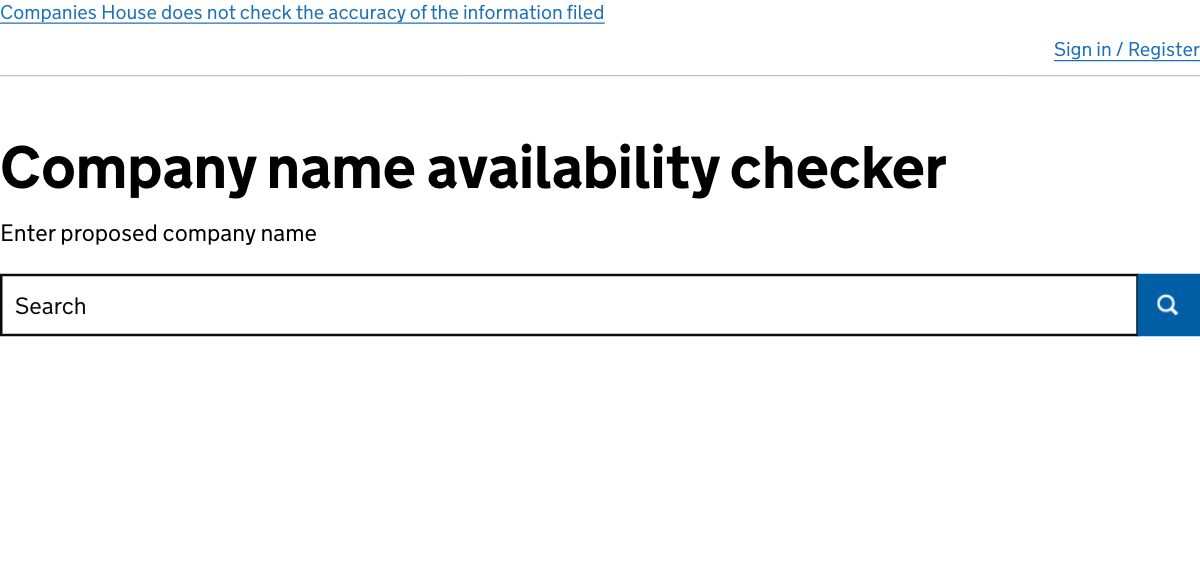
United Kingdom (Companies House). Search the Companies House company name availability checker first. GOV.UK sets out the rules: a private limited company name ends in "Limited" or "Ltd" ("Cyfyngedig" or "Cyf" for companies registered in Wales), it can't be the "same as" an existing name (differences only in punctuation, special characters or common company words don't count), Companies House can make you change a name that is "too like" another, and offensive names are refused. Sensitive words such as Bank, Insurance, Charity, Royal, Police or NHS need a letter of non-objection from the relevant body, and the GOV.UK guidance with the full list was last updated on 19 October 2026. A trademark owner can also complain if your company name is too close to their mark.
United States (state level plus DBA). Company names are registered per state, so search your state's Secretary of State business entity database; the SBA notes that most states don't allow a name somebody else already registered. If you trade under a name other than your own legal name or your entity's legal name, you file a DBA ("doing business as", also called a trade, fictitious or assumed name) with your state, county or city, depending on where you are. The SBA is clear that a DBA by itself gives no legal protection. For nationwide protection, you need a federal trademark through the USPTO.
Treat this section as general information: rules change, so read your own country's version before you register.
FAQ
How do I choose a good business name?
Write one sentence about your customer and your promise, brainstorm 50 names, filter them to 10 with the radio test and a length limit, check domain, handles, trademarks and the company register, and let 10 customers choose between the last 3 with a next-day recall test.
What makes a good business name?
It is easy to say and spell after hearing it once, short enough for a handle (around 15 characters or fewer), leaves room to grow beyond your first product or city, and is free in your category as a domain, trademark and registered company name.
Are business name generators any good?
For volume, yes. Shopify's free generator and AI chatbots give you hundreds of ideas in minutes. Use them for raw words, combine by hand, and run every finalist through the trademark and register checks yourself.
Can I use a business name if the .com is taken?
Yes, if nobody uses the same name in your category and no trademark blocks you. Use your country domain or add a short word to the .com. If the .com belongs to an active company in your field, pick another name: customers will end up on their site.
Do I need to trademark my business name?
Registering a company or trade name and registering a trademark are separate things. A trademark gives you stronger protection for your goods and services: across the EU with EUIPO, in the US with the USPTO, in the UK with the UK IPO. File once you have early revenue and plan to stay with the name.
What should you do next?
Block one week. Day one: the one-sentence brief and 50 names. Day two: filter to 10. Day three: availability checks. Days four and five: the customer recall test. End of the week: buy the domain and register the name. Then use the business startup checklist for registration, taxes and insurance, and the startup marketing plan example for your first 90 days of promotion. If you want a guided path from name to first paying customer, play Fe/male Switch, the startup game for women founders, where naming is one quest and your first sale is the next.