Co-Founder Matching: Where to Find a Co-Founder in 2027
Updated · First published
TL;DR
Co-founder matching works best when you treat it like hiring and dating at once: meet many people on a matching platform, run a short paid-off trial project with the two or three you like, and sign a founder agreement before you write any code or spend any money. The largest free option is Y Combinator's co-founder matching, with thousands of active profiles per big city and no equity taken. Pair it with one community where your future co-founder already spends time.

Not sure yet what kind of co-founder you need?
Fe/male Switch is a startup game where women founders build a company step by step and learn which roles they need before they go looking.
Where can you find a co-founder?
I'm Violetta Bonenkamp, founder of Fe/male Switch and co-founder of CADChain, which I run with Dirk-Jan Bonenkamp. Most good founding teams I know met through work, study or a shared project, and matching platforms are how you widen that circle on purpose.
| Option | What it is | Cost | Best for |
|---|---|---|---|
| YC co-founder matching | Profiles, a matching engine and invites to connect, run by Y Combinator | Free, no equity | Tech and startup founders in big startup cities |
| CoFoundersLab | Large online founder community with co-founder search | Free to join; premium options | Broad search across industries |
| Founder-first programmes (such as Entrepreneur First) | Programmes that back individuals before they have a team | Equity when a company forms | Technical founders ready to go full time |
| Startup games and incubators | Building a real project with other players | Low or free | Testing collaboration before committing |
| Your own network | Former colleagues, classmates, meetups, online communities | Free | People whose work you've already seen |
How does YC co-founder matching work?
Y Combinator's co-founder matching is free and takes no equity: "no commitment, no equity, no strings attached", in YC's words. It works in four steps:
- You create a profile about yourself, your skills and what you want to build.
- The matching engine shows you profiles that fit your preferences.
- You invite people who interest you to connect.
- When they accept, it's a match and you set up a first conversation.
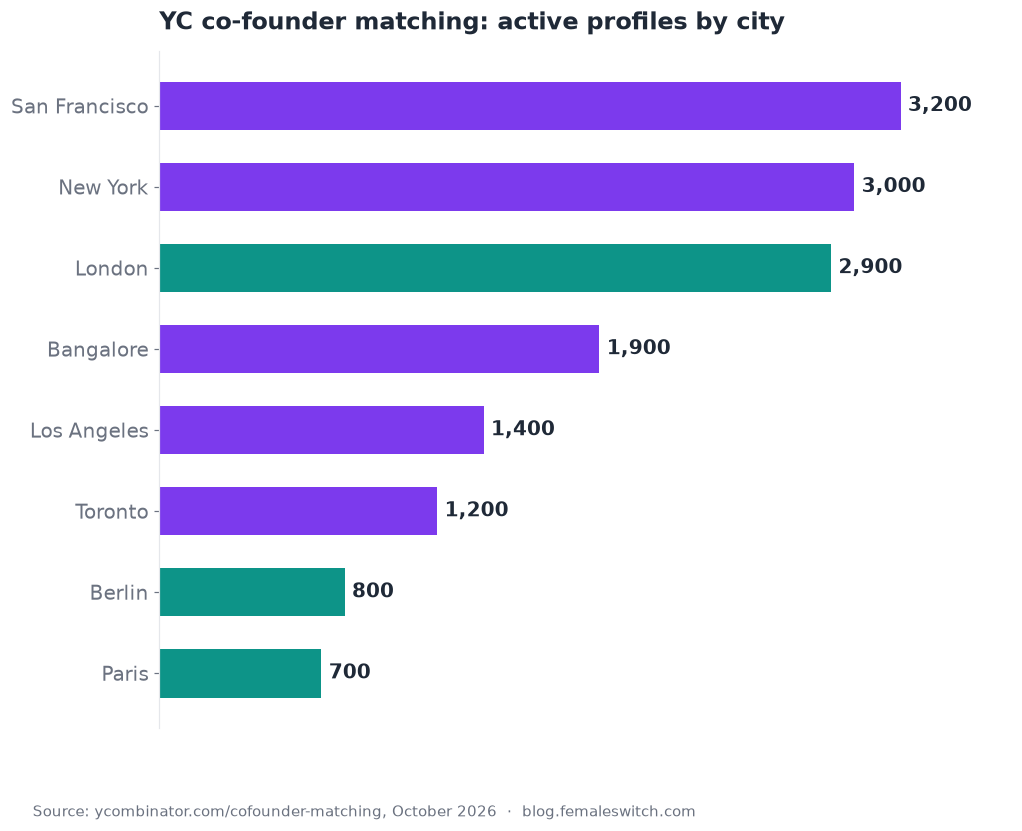
Anyone looking for a co-founder can join, with or without an idea. Profiles are only visible to other approved members. On its page YC lists the largest communities by city, led by San Francisco (3,200 active profiles), New York (3,000), London (2,900) and Bangalore (1,900), with Berlin (800) and Paris (700) as the biggest in continental Europe.
The matching feature sits next to YC's free online course; our guide to YC Startup School explains both.
How do you pick the right co-founder?
Skills are the easy part. These four questions decide whether a team survives its first hard year:
- Do you want the same company? Size, speed, funding, and whether you'd sell it. Write your answers down separately, then compare.
- Do your skills cover the gaps? One person close to customers and one close to the product is a classic pair.
- How do you handle disagreement? Ask about a conflict they had at work and how it ended.
- Can you both afford the plan? Months without salary, hours per week, and what happens if one of you needs to stop.
How do you test a co-founder before committing?
Next steps, in this order:
- Three conversations in two weeks: goals, roles, money. Use a shared document so nothing stays vague.
- A 4-week trial project with a real output: 15 customer interviews, a landing page with sign-ups, or a working prototype. Our startup checklist has the phase 1 steps that make a good trial.
- A written review at the end of week 4: what went well, what didn't, would you each start a company with this person?
- A founder agreement before the company is registered.
What should a co-founder agreement include?
A founder agreement (also called a shareholders' or co-founders' agreement) settles the questions that destroy teams later:
| Topic | What to agree |
|---|---|
| Equity split | Who owns what, and why |
| Vesting | Shares earned over time (four years with a one-year cliff is a common startup standard) |
| Roles and decisions | Who decides what, and how ties are broken |
| Leaving | What happens to shares when someone leaves, early or late |
| Intellectual property | Everything built for the company belongs to the company |
| Money | Salaries, expenses, and who puts in cash |
Have a lawyer review it once you know the terms. It costs far less than a co-founder fight a year from now. For how equity changes as you raise money, read our guide to startup funding stages.
FAQ
What is co-founder matching?
Co-founder matching is a service that connects people who want to start a company with potential co-founders, based on skills, interests and location. YC's matching, founder communities and some startup programmes all offer it.
Is YC co-founder matching free?
Yes. Y Combinator runs it as a completely free product and takes no equity. You create a profile, get suggested matches and invite the people you want to talk to.
How long does it take to find a co-founder?
Plan for a few months: several conversations a week, a trial project with your top candidate, then an agreement. Rushing to a 50/50 split with someone you met last week is the most common mistake.
Should I start a company without a co-founder?
Many founders start alone and add a co-founder or early employee once the idea has traction. Solo founders can be accepted by accelerators too; a strong team helps, a weak team hurts more than no team.
What should you do next?
Write down the skills and the working style you need, create a profile on one matching platform, and book three conversations this month. Run a 4-week trial before you share any equity. And if you want to learn which roles a startup needs by building one, play Fe/male Switch, the startup game for women founders.