Startup Simulator PC Games: 9 Picks and What Each Teaches
Updated · First published
TL;DR
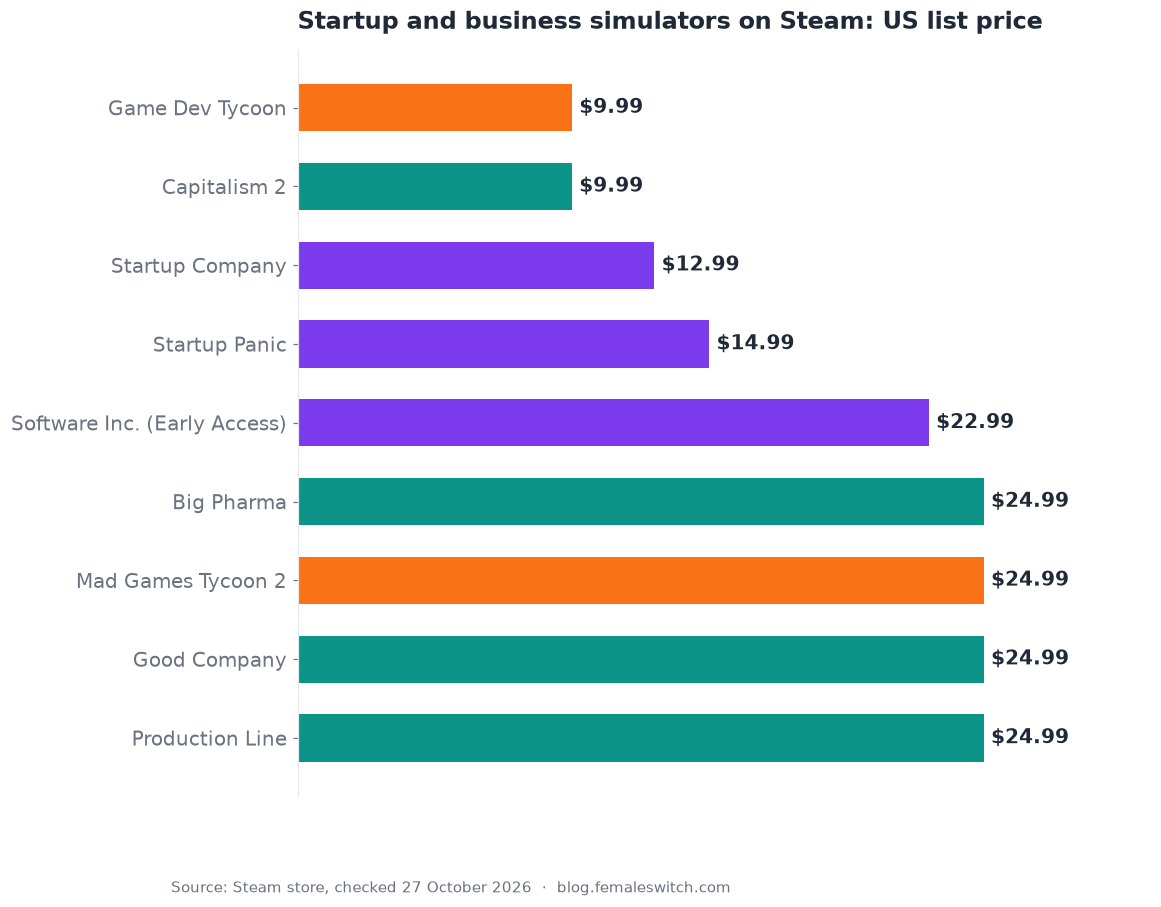
The best startup simulator PC games right now are Startup Company (run a website against tech giants, $12.99), Software Inc. (build a software and hardware company, $22.99, still in Early Access), Game Dev Tycoon (a game studio from the 1980s on, $9.99) and Capitalism Lab (a whole economy, $19.99 from the developer, with a Digital Age add-on for tech startups). Prices are US Steam list prices checked in October 2026. Each one trains a different founder reflex: cash, hiring, capacity or competition. None of them sends you to a real customer, so play for the habits and test your idea in the real world.

From simulator to your first real customer
Fe/male Switch is a browser-based startup game for women founders where your quests are real work: validate an idea, write a pitch deck and win over a mentor and an investor.
Which startup simulator PC games are worth playing in 2027?
I'm Violetta Bonenkamp, founder of Fe/male Switch, a startup game for women, and of the deep tech company CADChain. I look at business simulators with two questions: is it fun, and does the lesson survive contact with a real company? Here are nine that pass both.
| # | Game | Developer | You run | US price on Steam (Oct 2026) | Platforms | Best lesson for a founder |
|---|---|---|---|---|---|---|
| 1 | Startup Company | Hovgaard Games | A website competing with tech giants | $12.99 | Windows, Mac, Linux | Grow capacity and marketing together |
| 2 | Software Inc. | Coredumping | A software and hardware company (Early Access) | $22.99 | Windows, Mac, Linux | Teams, contracts and competing products |
| 3 | Game Dev Tycoon | Greenheart Games | A game studio starting in the 1980s | $9.99 | Windows, Mac, Linux | Read the reports, fix one thing per release |
| 4 | Mad Games Tycoon 2 | Eggcode | A game studio starting in 1976 | $24.99 | Windows, Mac | Growing from garage to corporation |
| 5 | Startup Panic | Algorocks (published by tinyBuild) | A tech startup through bubbles and rival CEOs | $14.99 | Windows | Surviving hype cycles |
| 6 | Good Company | Chasing Carrots | A tech manufacturer with production lines | $24.99 | Windows | Operations and product quality |
| 7 | Big Pharma | Twice Circled (published by Positech Games) | A pharmaceutical company | $24.99 | Windows, Mac, Linux | Seasonal demand and rivals' products |
| 8 | Production Line | Positech Games | A car factory | $24.99 | Windows | Bottlenecks and unit costs |
| 9 | Capitalism Lab | Enlight Software | Companies across a full economy | $19.99 on capitalismlab.com | PC | Supply chains, pricing, the stock market |
Prices are list prices without sales; Good Company was on a 40% discount when I checked. Steam prices change with sales and region, so check the store page before you buy.
What does each simulator teach a real founder?
1. Startup Company
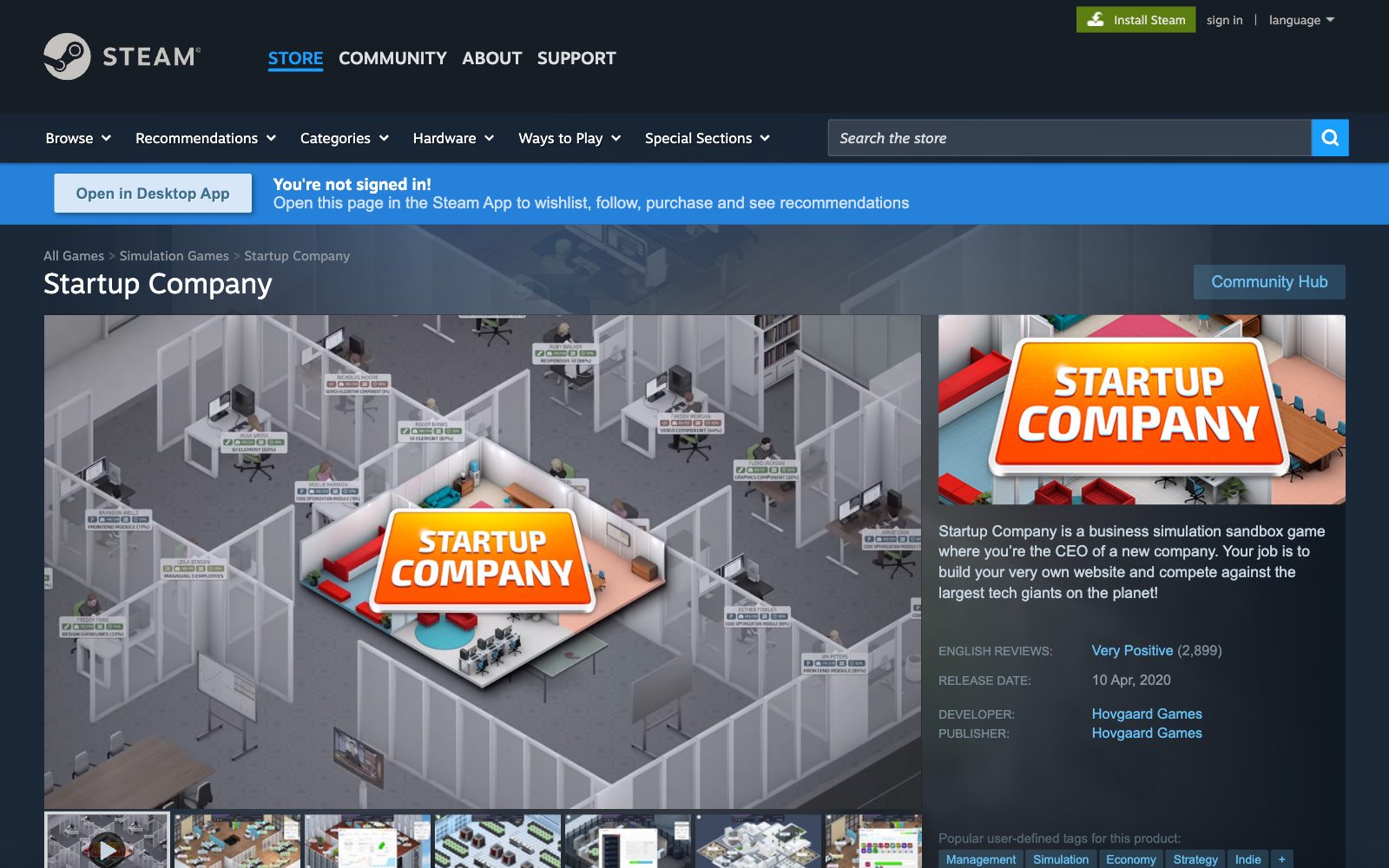
Startup Company by Hovgaard Games had its full release on Steam in April 2020. You are the CEO of a small startup with a small investment, and you build a website that competes with the largest tech companies. You keep developing features, add hosting capacity, run marketing campaigns, pick and decorate offices, and keep employees happy before competitors poach them. As traffic grows you move from virtual servers to your own hosting centre, and late in the game you can buy and merge competitors.
Real lesson: growth breaks things. Marketing that brings more visitors than your servers can handle hurts you twice, once in cost and once in reputation.
2. Software Inc.
Software Inc. by Coredumping has been in Early Access since 2015 and is the deepest of the tech-company simulators. You design office buildings, hire teams to design, build, support and market software and hardware, take contract work, file patents, trade stocks and even split the company between several founders. The market is simulated and randomised, so each run plays out differently.
Real lesson: contract work pays the bills while your own product matures. Plenty of real software companies started exactly this way.
3. Game Dev Tycoon
Greenheart Games released Game Dev Tycoon in 2013, and it remains the cheapest pick here at $9.99. You start in a garage in the 1980s, make simple games, research new technology, build your own engine and move into bigger offices. After each release the game gives you a report on what worked.
Real lesson: feedback is the product. Players who read the reports and change one thing per release win; players who guess lose money.
4. Mad Games Tycoon 2
Eggcode's Mad Games Tycoon 2 (2023) starts in 1976 and lets you build offices, production facilities and server rooms, and even your own console. It is Game Dev Tycoon with far more moving parts.
Real lesson: each new department adds fixed costs. Grow only when the current one pays for itself.
5. Startup Panic
Startup Panic by Algorocks, published by tinyBuild in 2022, starts with you quitting your job; then you survive the tech bubble, compete with rival CEOs and grow from a bedroom office to a corporate tower. It is lighter and funnier than the others, and Windows only.
Real lesson: hype cycles end. Cash in the bank decides who is still standing after one.
6. Good Company
Chasing Carrots released Good Company in 2022. You assemble production lines, manage employee logistics and sell high-quality tech products. It is closer to running a hardware company than a website.
Real lesson: quality and logistics are product decisions. If you plan to sell physical products, our tech business ideas list shows which ones are realistic for a small founder.
7. Big Pharma
Big Pharma by Twice Circled, published by Positech Games in 2015, mixes a business simulation with a logistics puzzle: you turn ingredients into medicine with machines that don't fit neatly into expensive factory space, while rivals launch competing cures and demand shifts with the seasons. It ships with 35 challenges across 7 scenarios.
Real lesson: a great product sold in the wrong season still flops. Timing is part of the product.
8. Production Line
Positech Games' Production Line (2019) puts you in charge of a car factory. You design a free-flowing line, beat competitors and still turn a profit.
Real lesson: every process has one bottleneck, and fixing it moves the bottleneck somewhere else. Operations in a ten-person company work the same way.
9. Capitalism Lab
Capitalism Lab by Enlight Software is the successor to Capitalism 2 and is sold directly by the developer for $19.99. Add-ons let you create subsidiaries with AI CEOs and list them on a stock exchange (Subsidiary, $9.99), shape city politics (City Economic Simulation, $9.99) and build a tech startup from its early days (Digital Age, $12.99). If you want the older classic, Capitalism 2 is on Steam for $9.99.
Real lesson: you can make or buy almost anything. Choosing what to build yourself and what to buy from a supplier is a real strategy decision, and this game makes you take it again and again.
Is there a free business game online?
Yes, two worth a look. Sim Companies is a free-to-play multiplayer business simulation (with in-app purchases) where you pick a production, retail or research company and trade in a player-driven economy. Fe/male Switch runs in your browser with a free Start tier; its paid Play tier, which gives full access to the startup game, costs €10 per month at the early-bird price. The difference: Fe/male Switch asks you to produce real work, such as a pitch deck, and to test your idea on real people. Our startup game for women guide walks through it.
What is the best Startup Company game strategy?
"Startup Company game strategy" is the most searched question around this topic. Exact numbers change with every patch, so here are the principles that hold, based on how the game works:
- Keep cash ahead of ambition. You start with a small investment. Every hire and every office upgrade is a monthly cost, so grow staff only when income covers it.
- Plan servers before campaigns. The game ties success to running a reliable website. Add hosting capacity before you launch a big marketing campaign, and move from virtual servers to your own hosting centre only when traffic justifies it.
- Ship features users want, in a steady rhythm. You have to keep developing and improving features. A steady stream beats one giant release.
- Look after your team. Employees ask for more as you grow, and competitors send them offers. Office comfort and fair pay are cheaper than rehiring.
- Decide early whether you buy or outrun rivals. The game lets you acquire competitors or push them out of business. Buying needs a cash pile, so save for it on purpose.
- Replay with one change. Change one variable per run (hiring pace, marketing budget) and compare. That habit transfers straight to real startups.
For strategy rules that work across every startup game, see our hub on the start up game.
Where does a simulator stop teaching?
Simulators give you clean data and fair rules. Real markets give you neither. Here is the gap I see founders fall into after a few hundred hours of tycoon games:
| What the simulator does for you | What you must do yourself in real life |
|---|---|
| Shows demand as a number | Talk to 20 or more potential customers before you build |
| Prices are given | Test prices with real offers and see who pays |
| Hiring is a click | Write contracts, pay taxes and keep people motivated |
| Funding arrives as a lump of cash | Pitch, negotiate terms and give up equity; see our startup funding stages guide |
| Marketing is a budget slider | Write the message, pick the channel, measure results; see our startup marketing plan example |
That doesn't make the games useless. Research on computer-based simulation games (Traci Sitzmann's meta-analysis of 65 studies in Personnel Psychology) found better knowledge and retention than comparison groups, as long as players took active decisions and a debrief followed. So after each session, write down one decision and what its real-world version would be. If you want to build a game like this for your own class or team, read our guide on how to make a business game.
FAQ
What is the best startup simulator on PC?
For a tech startup, Startup Company ($12.99) is the most focused and Software Inc. ($22.99, Early Access) is the deepest. For a broad economy, pick Capitalism Lab ($19.99 from the developer). For a cheap and gentle start, Game Dev Tycoon ($9.99).
What are the best business simulation games on PC?
Beyond tech startups: Big Pharma for products and seasonal demand, Production Line for factory operations, Good Company for manufacturing and logistics, and Capitalism Lab for supply chains and the stock market. All are on PC; Capitalism Lab is sold by its developer, the rest on Steam.
Is there a free startup simulator?
Sim Companies is free to play with in-app purchases, and Fe/male Switch has a free tier, with the full startup game in its paid Play tier. Most PC simulators are one-time purchases between about $10 and $25.
Which startup simulators run on Mac?
Startup Company, Software Inc., Game Dev Tycoon, Mad Games Tycoon 2 and Big Pharma all list Mac support on Steam. Startup Panic, Good Company and Production Line are Windows only there. Fe/male Switch runs in any browser.
Do business simulator games teach real skills?
They train decisions about cash, hiring, capacity and competition, and research shows better learning when play is active and followed by a debrief. They skip customer conversations, pricing tests and contracts, so combine them with a real test of your idea.
What should you do next?
Pick one game from the table that matches the company you want to build, play two runs, and change one thing in the second. Then take the best decision you made and test it on a real idea. If you are a woman founder and want a game where the quests are real work, start with Fe/male Switch, the startup game with an AI co-founder, a team, a mentor and an investor.