How to Start a Training Business: 8 Steps for 2027
Updated · First published
TL;DR
Starting a training business comes down to one sentence: find a skill that companies or professionals will pay to learn, turn it into a half-day workshop, and sell that workshop to five clients before you build a full catalogue. Start with one niche you know from your own work, price per session rather than per hour, and collect before-and-after evidence from every group you train. That evidence sells the next ten workshops.

Want to test your training offer before you build it?
Fe/male Switch is a startup game where women founders turn an idea into a first paying customer step by step, with an AI co-founder.
What kinds of training business can you start?
I'm Violetta Bonenkamp, founder of Fe/male Switch. I speak at universities and run workshops for founders, and the training businesses that work all solve a problem someone already has a budget for.
| Type | Who pays | Typical format |
|---|---|---|
| Corporate training (sales, leadership, software, compliance, AI tools) | HR and team managers | Half-day or full-day workshops, in-house or online |
| Professional skills (bookkeeping, project management, design tools) | Individuals, sometimes employers | Cohort courses, evening classes |
| Certification preparation | Individuals and employers | Courses tied to an exam |
| Founder and small business training | Founders, local governments, incubators | Bootcamps, programmes |
| Practical and hobby training (fitness, cooking, dog training) | Individuals | Classes, packages |
The rest of this guide focuses on training sold to companies and professionals, where budgets are larger and repeat business is common.
How do you start a training business step by step?
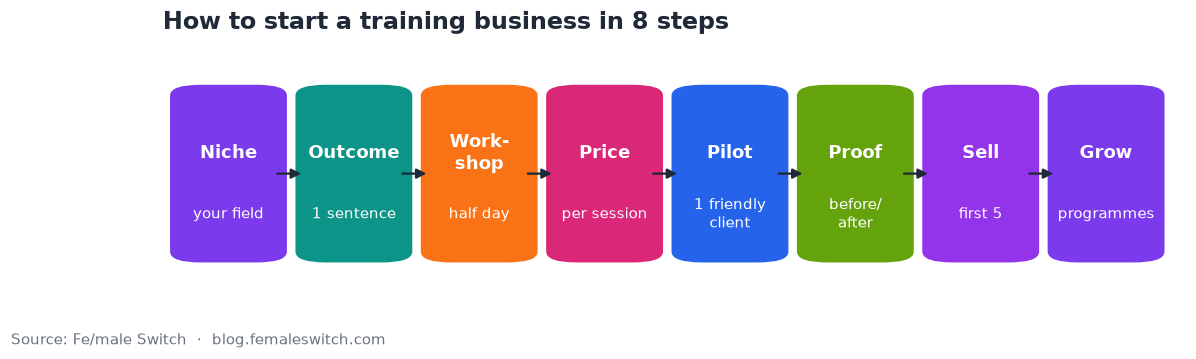
- Pick a niche from your own experience. "Excel for finance teams" or "AI tools for small marketing teams" beats "business training". You need credibility in the room.
- Define the outcome. Write what participants can do after the session that they couldn't before, in one sentence. Companies buy outcomes.
- Design one workshop. Half a day, three parts, exercises on the participants' own work. A good rule: talk for a third of the time, let them practise for two thirds.
- Set a price per session, not per hour. Our rough estimate for in-house workshops in Western Europe: €1,000 to €3,000 per half day for a group, depending on niche and your track record.
- Run a pilot with a friendly company at a discount, in exchange for a testimonial and permission to share results.
- Collect proof. Measure something before and after: time saved, errors made, a quiz score. Numbers sell training.
- Sell to your first five clients through your own network, LinkedIn and partners such as consultancies, associations and coworking spaces. Our startup marketing plan example shows a 90-day outreach plan that fits a training business.
- Grow into programmes: a series of sessions, an online course for the parts that don't need you live, and train-the-trainer licences once demand outgrows your calendar.
What does it cost to start a training business?
Very little compared with other businesses. Our rough estimate for a one-person start: €500 to €3,000 for a website, a video meeting tool, slide templates, liability insurance and your first marketing. Venue costs come later, and many companies host in-house training themselves.
The real investment is your time to build the first workshop: plan two to four weeks to design, test and improve it. Put the business on a legal footing with our business startup checklist, and if you want formal training on starting a company yourself, see our list of courses to start a business.
How do you get clients for a training business?
- Start with people who already trust you: former employers, colleagues, clients.
- Teach in public: short LinkedIn posts or videos that solve one small problem from your workshop.
- Partner with people who sell to your buyers: consultants, software vendors, HR agencies.
- Ask every group for a referral at the end of the session, while the energy is high.
- Answer tenders and requests from local governments and incubators for founder or skills training.
FAQ
How do I start a training business with no experience?
Start in a field where you have work experience even if you've never trained anyone. Run free sessions for a community or a friend's team to practise, collect feedback, then charge for the improved version.
Is a training business profitable?
Training businesses have low costs, so most of the price stays with you once you have clients. Income depends on how many sessions you sell; repeat clients and programmes make it steadier than single workshops.
Do I need a certification to start a training business?
For most corporate and professional training, no; clients care about your experience and results. Some fields, such as safety, health or regulated finance, require certified trainers, so check the rules in your country and sector.
Should training be online or in person?
Both sell. In-person workshops build more trust and command higher prices; online sessions scale across cities. Many trainers sell in person first and add online cohorts once the material is proven.
What should you do next?
Write your niche and outcome in one sentence each, design one half-day workshop this month, and pitch a pilot to three companies you know. If you want a structured path from idea to first paying client, play Fe/male Switch, the startup game for women founders.