Internet Business Ideas 2027: 15 Online Models With Costs
Updated · First published
TL;DR
The best internet business ideas for a small founder in 2027 sell a skill or a narrow product to a clearly named group of buyers: AI set-up services for small companies, digital products, paid newsletters, and niche online stores. Generic dropshipping got harder after the US ended its duty-free import rule for small parcels in August 2025 and the EU added a €3 duty per item on parcels under €150 from 1 July 2026. Pick one idea from the table below, check the platform fees before you set prices, and get 10 paying customers before you spend on ads or stock.

Test your internet business idea before you spend money
Fe/male Switch is a startup game for women founders: you take one idea to your first paying customer step by step, with an AI co-founder next to you.
What counts as an internet business in 2027?
I'm Violetta Bonenkamp, founder of Fe/male Switch, a startup game that runs entirely online, so this topic is my daily work. An internet business is any business where customers find you, buy from you and receive what they paid for mostly through the web: a service delivered over video calls, a file they download, a subscription, or a product shipped after an online order.
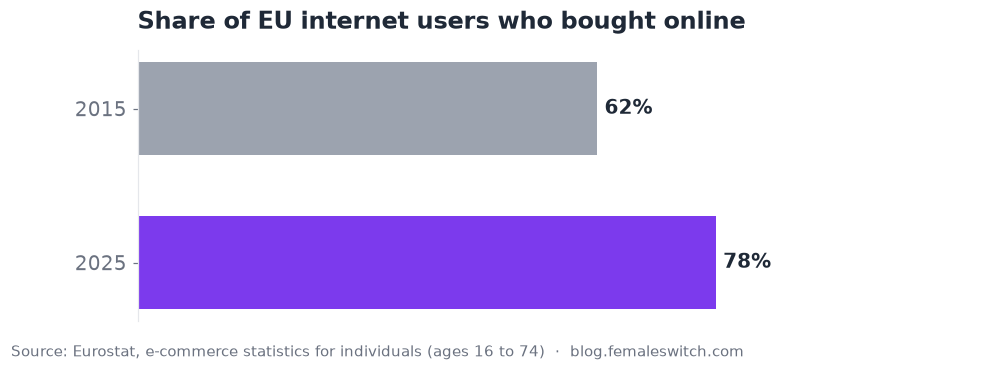
The demand side is settled. In 2025, 78% of EU internet users aged 16 to 74 bought something online, up from 62% in 2015, according to Eurostat. In the United States, online sales reached $340.2 billion in the second quarter of 2026, or 17.1% of all retail sales, 12.2% more than a year earlier, according to the US Census Bureau.
The more interesting number for founders sits on the supply side. Only 20% of EU companies with 10 or more employees used any AI technology in 2025, and among small companies (10 to 49 people) the share was 17%, according to Eurostat. Four out of five of those companies use no AI at all, and that gap is where the fastest internet startup ideas of this year live.
Which internet business ideas work best right now?
The budgets below are our own rough estimates for a one-person start in Western Europe in 2027: tools, a domain, small test budgets and, for physical goods, a first batch of stock.
| # | Idea | Rough starting budget (our estimate) | Time to first income (our estimate) |
|---|---|---|---|
| 1 | AI workflow set-up for small businesses | €100 to €600 | 2 to 6 weeks |
| 2 | AI content repurposing studio for experts | €100 to €500 | 2 to 6 weeks |
| 3 | Customer support chatbot set-up | €200 to €800 | 1 to 2 months |
| 4 | AI training workshops for teams | €200 to €1,000 | 2 to 6 weeks |
| 5 | Online operations assistant agency | €100 to €500 | 2 to 4 weeks |
| 6 | Templates and digital downloads | €0 to €300 | 1 to 3 months |
| 7 | Practical ebooks and guides | €0 to €800 | 2 to 4 months |
| 8 | Paid niche newsletter | €0 to €200 | 3 to 9 months |
| 9 | Live cohort course | €200 to €1,500 | 1 to 3 months |
| 10 | Micro software tool or browser extension | €500 to €5,000 | 3 to 9 months |
| 11 | Niche online store (one product category) | €2,000 to €10,000 | 2 to 6 months |
| 12 | Handmade or print-on-demand shop | €100 to €1,500 | 1 to 3 months |
| 13 | Dropshipping with local suppliers | €500 to €3,000 | 1 to 3 months |
| 14 | YouTube channel for one topic | €300 to €2,000 | 6 to 18 months |
| 15 | Affiliate review site for one niche | €100 to €800 | 6 to 12 months |
Which AI-assisted internet businesses can you start this month?
Services need almost no money and pay you while you learn what customers want.
1. AI workflow set-up for small businesses
Accountants, clinics and webshops repeat the same tasks: answering the same emails, copying data between tools, writing quotes. You map one process, connect a language model with a no-code automation tool, and hand over a working workflow plus a short video manual. Sell it as a fixed-price package ("inbox triage set up in 5 days: €1,200") and add a monthly support fee.
2. AI content repurposing studio for experts
Coaches and consultants record podcasts and webinars that nobody revisits. You turn each recording into a blog post, a newsletter, LinkedIn posts and short clips, with AI writing the first draft and you editing it until it sounds human. A monthly retainer per client makes this one of the steadiest business ideas for digital business beginners.
3. Customer support chatbot set-up
Small webshops want a chatbot trained on their own FAQ, return policy and product data. Know the rules before you sell it: under Article 50 of the EU AI Act, transparency duties apply from August 2026, which means people must be told when they are talking to an AI system unless that is obvious, and synthetic content must carry machine-readable marking. Build the disclosure into every bot you deliver and you have a selling point your cheaper competitors forget.
4. AI training workshops for teams
Many companies pay for AI licences that staff use as a fancy search box. A half-day workshop built around the team's real documents and tasks sells well to companies with 10 to 49 people, the same group where Eurostat counted only 17% AI use in 2025.
5. Online operations assistant agency
Start as a solo virtual assistant who uses AI tools to work twice as fast, then hire other assistants once your calendar is full. Freelance marketplaces help you find the first clients, so know their cut: Fiverr keeps 20% of each order according to its help centre, and Upwork charges freelancers a variable fee of 0% to 15% per contract, shown before you send a proposal, according to Upwork. Move happy clients to direct invoicing as soon as your contract terms allow it.
Which digital products sell best on the internet?
Every extra sale of a digital product is close to pure margin. The catch is distribution, so pair the product with a newsletter, a channel or a service from the list above.
6. Templates and digital downloads
Notion workspaces, Canva kits, contract templates, planning checklists. The narrower the buyer, the easier the sale: "booking kit for Dutch wedding photographers" beats "business templates". Gumroad charges 10% plus $0.50 per sale made through your own profile or links, and 30% when a new buyer finds you through its Discover marketplace, according to its pricing page. Since 1 January 2025 Gumroad also handles sales tax and VAT as merchant of record in the regions where it has that obligation.
7. Practical ebooks and guides
Amazon Kindle Direct Publishing pays either a 35% or a 70% royalty on ebooks; the 70% option applies to in-copyright works sold in listed territories and subtracts a small delivery cost per copy, according to KDP's royalty rules. Let AI draft outlines and write the experience-based parts yourself.
8. Paid niche newsletter
A newsletter for one profession or one hobby can charge €5 to €15 a month. Substack keeps 10% of paid subscription revenue and Stripe adds its card fees on top, according to Substack's own support page. Expect several months of free issues before the first paid subscribers arrive.
9. Live cohort course
A four-week live course for 10 to 30 people lets you test your material before you record anything. Sell the first cohort before you build the slides.
10. Micro software tool or browser extension
AI coding assistants let non-engineers build small tools: a Shopify app that fixes one annoying task, a browser extension for recruiters, a calculator for a niche profession. This idea has the highest upside and the slowest start in the list, so run it next to a service that pays your bills. Our guide to tech business ideas covers more software models.
Which creator and niche e-commerce models still make money?
E-commerce has the biggest market and the thinnest margins, so own a niche that big retailers ignore.
11. Niche online store
One product category for one type of buyer: refill cleaning products for small offices, adaptive clothing, gear for one dog breed. Shopify's smallest full store plan was listed at €28 a month, or €21 a month on yearly billing, on its pricing page when we checked in October 2026; prices differ by country. A good name matters more than people think, so read our online store name ideas before you buy a domain.
12. Handmade or print-on-demand shop
Etsy charges a $0.20 listing fee for each item and a 6.5% transaction fee on the sale price including shipping, plus payment processing and optional or mandatory Offsite Ads fees of 12% or 15% on attributed sales, according to Etsy's 2025 annual report. Print-on-demand removes stock risk and also removes most of your margin, so price your designs as premium products.
13. Dropshipping with local suppliers
Shipping cheap goods from overseas warehouses lost its price edge. The United States suspended duty-free treatment for low-value imports from all countries on 29 August 2025, according to US Customs and Border Protection. The EU followed with a €3 customs duty per item category on parcels worth up to €150 from 1 July 2026, paid by non-EU sellers and importers, according to the European Commission. Dropshipping still works when your suppliers sit in the same market as your buyers and ship in days.
14. YouTube channel for one topic
YouTube lets you join its Partner Program, which shares ad revenue, after 1,000 subscribers plus either 4,000 watch hours in 12 months or 10 million Shorts views in 90 days, according to YouTube Help. Treat ad money as a bonus; the real income comes from sponsorships and your own products.
15. Affiliate review site for one niche
Affiliate commissions reward honest, tested reviews for a narrow group of buyers. Keep it clean: the US Consumer Reviews and Testimonials Rule, in force since 21 October 2024, bans fake reviews and lets courts fine businesses that knowingly break it.
How much do platform fees take from an internet business?
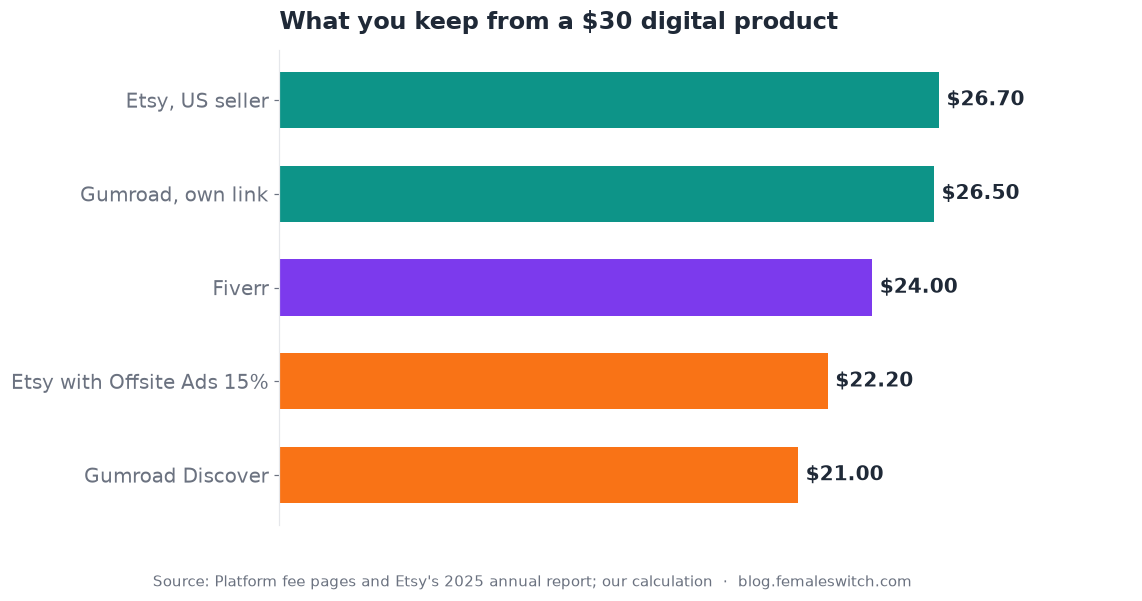
Here is what each platform takes from a $30 digital product, using the figures above. This is our own calculation and leaves out taxes and currency conversion.
| Platform | What it charges | You keep from $30 (our calculation) |
|---|---|---|
| Gumroad, sale through your own link | 10% + $0.50 | $26.50 |
| Gumroad, sale through Discover | 30% | $21.00 |
| Etsy, US seller, no Offsite Ads | $0.20 listing + 6.5% + 3% + $0.25 processing | about $26.70 |
| Etsy, sale attributed to Offsite Ads at 15% | add 15% | about $22.20 |
| Fiverr service sold for $30 | 20% | $24.00 |
The Etsy processing figure of 3% plus $0.25 applies to US sellers; Etsy's annual report says processing fees range from 3% to 6.5% plus a flat fee that depends on your bank country. Three habits protect your margin:
- Set prices after fees, never before.
- Send repeat buyers to your own shop or newsletter, where the platform cut is lowest.
- Recalculate every quarter, because platforms change their fees with little notice.
Which rules apply to an online business in 2027?
The rules that catch new internet founders most:
- EU VAT on online sales: once your cross-border sales to consumers in other EU countries pass €10,000 a year, you charge VAT at the buyer's national rate, and the One Stop Shop lets you declare it in one country, according to Your Europe.
- AI transparency: chatbots and AI-generated content fall under Article 50 of the EU AI Act from August 2026.
- Import duties: the US and EU small-parcel changes hit any model that ships cheap goods across borders.
Check your own country's rules with a local adviser before you sell across borders. Our startup checklist lists the registration, insurance and tax steps in order.
How do you test an internet business idea before spending money?
Next steps, in this order:
- Name one buyer and one problem. "Physiotherapists who lose hours on appointment emails" beats "small businesses".
- Write the offer on one page with a price, a delivery date and a way to pay or book.
- Talk to 20 people from that group where they already spend time, and ask each one for a payment or a pre-order.
- Deliver to the first 10 by hand, even the parts you plan to automate later, and write down time spent, questions asked and what they would pay next time.
- Draw the business on one page. Our business model canvas examples show how to fill in customers, channels and costs.
- Plan your first 90 days of marketing with our digital marketing plan for startups.
Need more starting points? Our list of low cost startup business ideas adds offline options, and the Business Ideas for Low Investment site scores low-cost business ideas by cost, skills and hidden risks.
FAQ
What is the best internet business to start with no money?
A service built on a skill you already have: AI workflow set-up, content repurposing, an online operations assistant service or a niche templates shop. You need a laptop, a few tool subscriptions and a one-page offer. Digital products need an audience before they sell.
Which internet business opportunities are real and which are scams?
A real internet business opportunity sells something specific to a named group of customers, and you can check its costs and fees yourself. Walk away from offers that charge you up front for "a ready-made store", promise income figures without proof, or earn mainly by recruiting new members. World Best Business Opportunity offers a scorecard to weigh the best business opportunity against your skills, costs and risks.
How much does it cost to start an internet business?
By our estimates, services start from about €100, digital products from close to zero, and a niche store with its own stock from €2,000 to €10,000. The largest hidden cost is your time before the first sale.
What are good internet startup ideas that use AI?
AI set-up services for small companies, chatbots trained on a shop's own data, AI training workshops, content repurposing studios and micro software tools built with AI coding assistants.
What should you do next?
Pick one idea from the table, name one buyer, and get your first payment within 30 days. If you want a structured way to go from an internet business idea to your first customer, play Fe/male Switch, the startup game for women that walks you through validation, pricing and your first sales, with an AI co-founder for founders who start with little money and no technical partner.